QT Scan vs. mammogram: an honest comparison.
Not a takedown of one or a sales pitch for the other. Just a clear look at how each works, and how to decide what belongs in your screening life.
When women hear about the QT Scan, the first question is almost always some version of: “So is it better than a mammogram?” It is an understandable question, and the honest answer is more useful than a simple yes or no.
How a mammogram sees.
Mammography is an X-ray. The breast is compressed between two plates to spread the tissue, and low-dose radiation passes through it to create a two-dimensional image (or, in tomosynthesis, a series of thin slices). Mammography has decades of data behind it, it is widely available, it is typically covered by insurance, and it remains the standard of care for population-wide screening.
Its trade-offs are also real: it uses ionizing radiation, it requires compression that many women find painful enough to delay or skip screening, and in dense tissue its X-ray images can struggle to distinguish overlapping structures.
How the QT Scan sees.
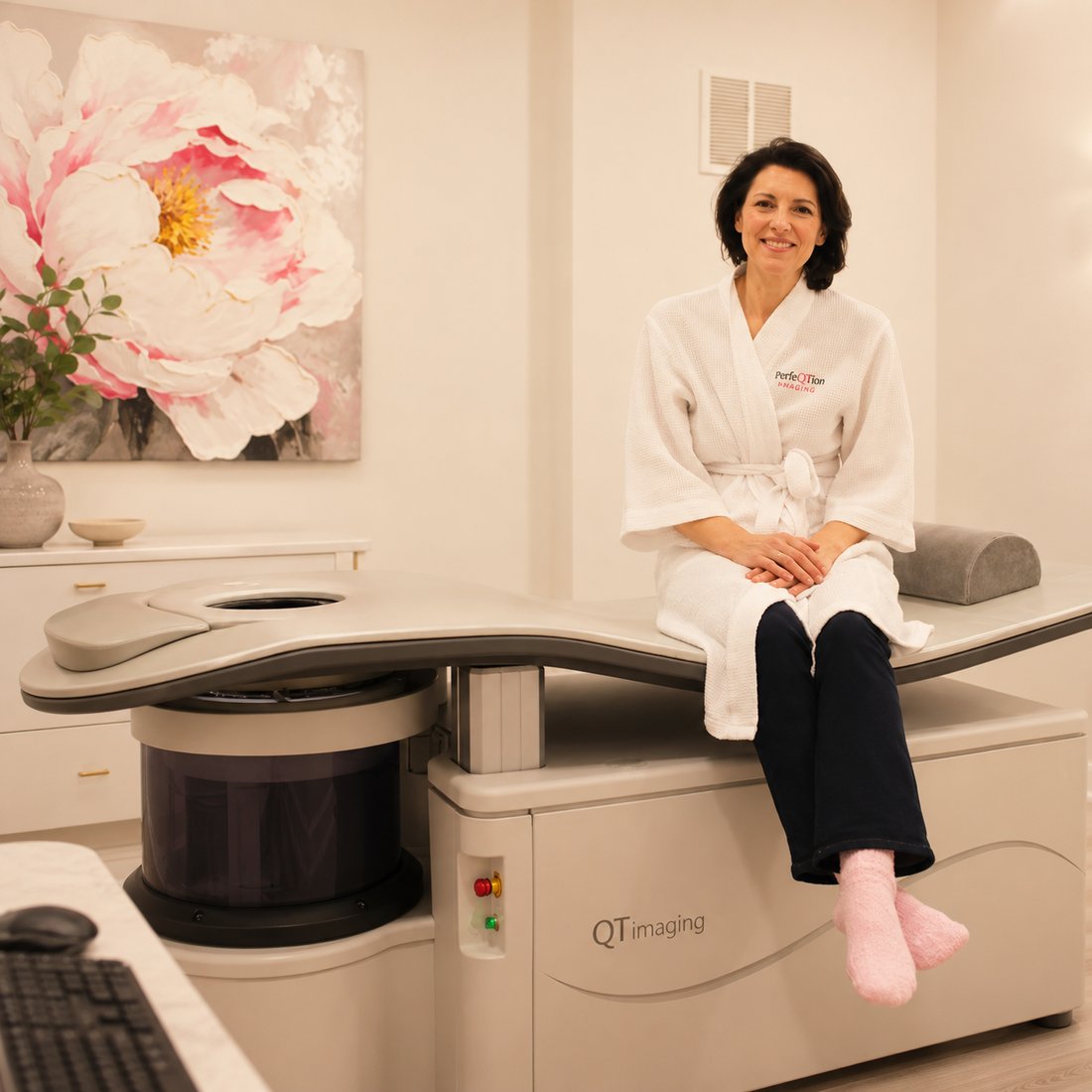
QT imaging is FDA-cleared, radiation-free technology that works on an entirely different principle. You lie face down on a padded table with one breast at a time suspended in warm water. Sound waves pass through the tissue, and a computer reconstructs a true three-dimensional image from how those waves travel, no compression, no contrast injection, no radiation. Each side takes about ten minutes.
Because it is built from transmitted sound rather than X-ray shadow, QT imaging produces very high-resolution images and is designed to see clearly through dense tissue, the exact situation where mammography works hardest.
The honest differences, side by side.
- Radiation: mammography uses a low dose; QT uses none. For a test repeated annually for decades, that difference compounds.
- Comfort: compression versus warm water. Comfort sounds like a luxury until you remember that dreading a test is one of the main reasons women delay it.
- Dense tissue: QT’s transmitted-sound approach is not degraded by density the way X-ray contrast can be.
- Evidence base and coverage: mammography has the longer track record and broad insurance coverage. QT is newer, is typically self-pay, and results are read by board-certified, QT-trained radiologists.
- What happens with a finding: either path leads to the same place, appropriate follow-up with your care team. Neither replaces diagnosis.
How to decide.
For some women, QT imaging is a complement to the screening they already do, a radiation-free look between mammograms, or added clarity for dense tissue. For others, particularly women who cannot or will not undergo compression or radiation, it becomes the screening they finally keep. Your history, your density, your risk factors, and your own preferences all belong in that decision, ideally in conversation with a clinician who will lay out both paths without pressure.
That is a conversation we are always glad to have, and if the right answer for you is not us, we will say so.